Scrubbing Beneath the Surface of the Environmental Services Industry
Meet Tracy Tan, a 37-year-old Key Account Manager, as she shares about her job and how the Environmental Services industry plays an important role in upkeeping high standards of public cleanliness and hygiene in Singapore.

Tracy Tan is the driving force behind the team of 120 cleaners at ISS Facilities Services Pte Ltd.
Since the COVID-19 pandemic, the importance of high hygiene standards has thrust environmental services into the foreground. Suddenly, cleaning is no longer about routine operations of keeping the environment clean, but has become a critical factor in safeguarding public health and safety, protecting against infectious diseases.
No one understands this better than Tracy Tan, Key Account Manager with ISS Facilities Services Pte Ltd (ISS), who manages the cleaning contracts of two major hospitals in Singapore. “When I first started in 2016, my role was mainly in projects and account servicing. Things were business as usual. After the COVID-19 pandemic, the demand for cleaning services doubled and clients demanded higher cleaning standards”, she said. “For example, we now have to ensure that high-touch areas, such as lift buttons and door handles, are thoroughly disinfected.”
To ensure that high cleaning standards are met, Tracy acts as the conduit between her cleaning crew, affectionately known as Placemakers within ISS, and her clients. Apart from conveying clients’ expectations to her team, Tracy visits hospitals regularly to gather feedback from the Placemakers to understand their operational difficulties and pain points. This is not an easy task, as Tracy needs to work with multiple parties to keep up with cleaning requirements at the hospitals. Specifically, Tracy’s team needs to ensure that hospital toilets are kept clean and dry to prevent slips and falls among users.
Tracy emphasised, “Keeping spaces clean is not a one-way street. I’m grateful that my clients do their part to help remind users to keep toilets clean and bin their rubbish properly. The collective efforts of hospitals and members of the public help to improve working conditions for the Placemakers, and most importantly, keep the environment clean for everyone”.
Starting with a Clean Slate
In a typical day, Tracy is also involved in other behind-the-scenes duties, such as recruitment and training.
Ensuring that the job is done right starts with hiring the right person, and Tracy takes it upon herself to directly interview potential candidates. “My interviews are done in person, at the site where the Placemakers will be deployed, so that they can visualise their work environment, and meet the supervisors they would be working with.”

With her warm and easy-going personality, Tracy is always ready for a chat with her teammates.
Tracy personally gets involved in the training of her Placemakers. As a Biomedical Science graduate, Tracy leverages her technical knowledge to explain to them the science behind cleaning. Despite the majority of her Placemakers being aged in their fifties and sixties, they are eager to embrace the use of technology, and are excited whenever Tracy shows them how to operate new machinery or equipment.
Most people are unaware that being in the environmental services industry means being immersed in the latest use of technology or tools, such as data analytics and the Internet of Things, for problem-solving.
Due to the COVID-19 pandemic, cleaning frequencies have increased, and this has led to a surge in workload for Tracy’s staff. To help them cope with their duties, she has worked with her clients to introduce a slew of innovative solutions in hospitals. For example, robots are deployed to clean and disinfect corridors of hospitals, so that the Placemakers can focus on hard-to-reach areas. Sensors are placed in trash bins and toilet roll holders, to track when these need to be emptied or replenished. An application would send out a notification to staff, whenever these areas require attention. This has helped the Placemakers to work more efficiently as they no longer need to conduct ad-hoc checks.
Tracy likes to put on her analytics hat and brainstorm ways to improve work processes or develop new initiatives for her clients. For example, she has used the data she collected on how often trash bins are being emptied to identify peak periods. With this, she knows when and where to deploy her manpower. In addition, the touchscreen feedback systems in toilets also allow Tracy to identify problem areas, such as faulty equipment. With such information at her fingertips, Tracy can send staff to quickly rectify these problems.
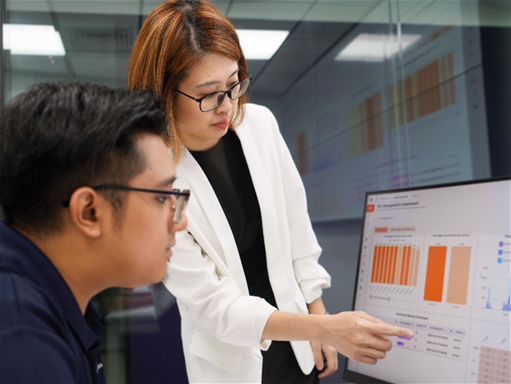
Tracy uses analytics and dashboards to help with strategic planning and trend studies.
A Bright Spark
Tracy’s friendly and approachable disposition has found her team coming to her with their personal problems as well. At times, Tracy feels like she is like a parent to her Placemakers. “Other than coaching them on their work, I sometimes lend them a listening ear. I am almost like their life coach”, she laughed. Drawing upon her own valuable experiences with mentors within the company, Tracy is keen to impart similar support to their staff, recognising the significant impact that good mentorship has had on her own growth and development. “I help them to prioritise their work and personal goals, so that they can be more effective in the way they do things.”
This is a ‘role’ that Tracy does not mind at all, as her Placemakers keep her motivated and give her a sense of purpose in her work. “They are my inspiration!” she quipped. Tracy finds joy in small wins, be it a thank you from her Placemakers for teaching them something new, or a compliment from her clients about her Placemakers.
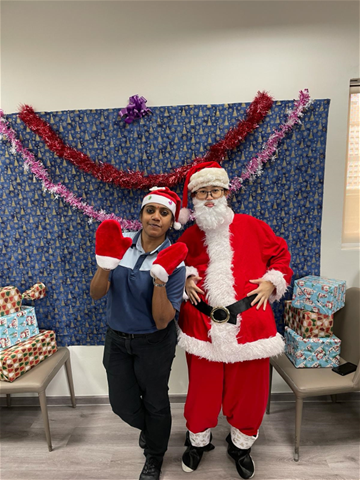
Tracy disguised as Santa Claus during one of the team’s get-together sessions. She improves bonding with the crew by organising games and buying them lunch every quarter.
On to her eighth year with ISS, Tracy realises that only 10 per cent of her time is focused on technicalities, while the bulk of it is spent managing relationships. “The majority of my work is about stakeholder management, and this applies to both internal and external stakeholders”, she said. As demand for cleaning services continues to rise, increasing manpower to meet service demand is not sustainable, given Singapore’s manpower constraints. To address this challenge, Tracy tries to persuade her clients to adopt outcome-based cleaning contracts (OBC), instead of traditional contracts where the focus is on manpower or the number of man-hours put into a job. When clients adopt OBCs, Tracy can deploy solutions using robots or technology, cutting down reliance on the Placemakers. For OBCs to be effective, Tracy needs to encourage her Placemakers to be open in picking up new skills. Members of the public can also do their part to keep Singapore clean, by picking up after themselves. “The combined effort of everyone would not only help to improve Singapore’s cleanliness, but would push the Environmental Services industry towards innovation,” Tracy added.
It is Tracy’s hope that more can be done to raise awareness of exciting opportunities in the industry. “Roles in the industry go beyond cleaning duties,” she explained. “They also encompass other areas of work, such as engineering, environmental risk assessment, consultancy services, and even data analysis. The COVID-19 pandemic has shed light on how important the industry is. Come join us and see for yourself!”