In Singapore's densely populated urban landscape, rats are among the most adaptable and resilient species. Rats thrive in environments with abundant food sources and harbourage areas which facilitate population growth and establishment. These highly adaptable animals can learn quickly to avoid new objects and baits, making control efforts challenging. When conditions are favourable, rats reproduce rapidly, allowing populations to expand and establish themselves in the environment.
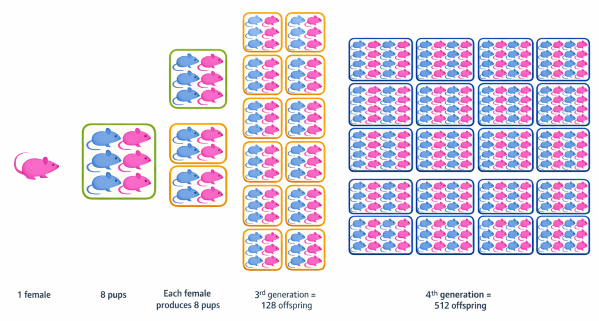
Rats can multiply rapidly if left unchecked. Upon reaching reproductive maturity at the age of 3 months, female rats can have up to 7 litters per year of 6 to 12 pups each, and they can become pregnant again just hours after giving birth.
Diagram 1: Potential number of offspring from one pregnant female in less than a year, assuming 50% males and females, and all offspring survive and breed, and all females only give birth once.
Proper upstream waste management, food hygiene and rectification works for structural defects to deny rats of food sources and harbourage are important to prevent rat infestation.
Uncontrolled rat infestation can impact us negatively in many ways including:
- Public health risks: Rat can carry and spread dangerous diseases such as Leptospirosis, Murine Typhus and Hantavirus infection directly or indirectly by contaminating our environment, food and water sources.
- Property damage: Rats can gnaw on and damage goods, wires, insulation and other building materials, which can lead to costly repairs and even pose a fire hazard in some cases.
- Reputation: Rat sightings create negative perceptions that may result in business disruption, enforcement action and potential loss of customers, income and business opportunities.
- Other legal and finances consequences: Beyond cleanup and sanitation costs, premises owners and managers maybe liable for any damages, injuries or health-related issues caused by rat infestations.
Everyone needs to work together to keep our neighbourhoods clean and rat-free.