Innovation Call for Rat Tracking Solutions
Rats transmit diseases such as murine typhus, leptospirosis and hantavirus infection. The National Environment Agency (NEA) of Singapore is committed to keeping the incidence of rat-borne diseases low. NEA carries out rat surveillance and control, along with other efforts such as Research and Development (R&D) to understand rat ecology and behaviour. A better understanding of the rats’ nesting area and environment, and their travel patterns, such as their travel path to sources of food in our urban environment enables NEA to develop more effective strategies to tackle rat issues.
NEA is calling for proposals to develop an underground burrow mapping and rat tracking solution(s) to:
- Work Area A - Map the underground rat burrow network; and
- Work Area B - Track the location and movements of rats.
The information and data collected from Work Area A and B are to be produced for the users to meaningfully visualise and understand the extent of rat infestation in the locality studied.
Interested parties may submit proposals for (i) either Work Area A or Work Area B or (ii) both Work Areas.
1. Background
1.1. Government agencies, estate/building management agents and premises owners engage Pest Control Operators (PCOs) for rat control services. In an outdoor environment, active rat burrows are usually used to locate the area of heightened rat activity. However, the presence of surface rat burrows may not reflect the extent of the rat infestation underground. Moreover, time consuming and laborious investigation is usually needed to determine the extent of the infestation before trapping and treatment works can be carried out.
1.2. Rats typically build a network of underground tunnels with multiple opening/exit holes, as pathways to their feeding zones or nesting areas. Rats can adapt to man-made structures such as underground drains/lines, bin chutes, false walls and structural defects easily. The current method of detection based on line-of-sight limits the number of rat burrows that can be detected. There is currently a lack of information on the extensiveness of the underground burrow network and the pathways taken by rats, as well as the rat population.
Desired Outcomes
1.3. With a rat tracking system, NEA will be able to effectively gather reliable intelligence on the extent of the underground burrow network. Information such as the rat movements, pathways taken and rat nesting grounds in the burrows can be assimilated to plan targeted rat inspection efforts and guide PCOs to deploy more effective rat control measures such as treatment at the nesting grounds. Periodic surgical rat culling operations can be undertaken and a reduced need for human surveillance efforts will lead to increased productivity in the industry. Such a rat tracking system can assist NEA to conduct backfilling, treatment and assessment of biologically based rodenticide to test their efficacies.
2. Scope of Call for Proposals
2.1.
This call for proposals consists of two work areas as follows:
Work Area A: To map the underground rat burrow network
Develop a mapping solution to map the key features of underground rat burrow network, minimally at grassy area and concrete building substructures such as housing block bin chutes, with the following key functionalities:
(i) Detect and map the underground rat burrow network to a depth of two metres from the surface,
(ii) Produce the information and data collected for the users to meaningfully visualise and understand.
This shall include, but not limited to, the following:
a) the location, depth and size of the burrows,
b) whether the burrows are active and identify any rat infestation (optional),
(iii) Provide a user-friendly interface for the user to visualise, understand, process and output the data
and information into commonly used digital file format(s) for further analysis.
Work Area B: To track the location and movements of rats
Develop a rat tracking system to trace the pathways taken by rats, with the following key functionalities:
(i) Device(s) that can be attached to rats for tracking, or any other tracking methodologies, and establish the rat routes with timestamps and movement patterns over a period no shorter than two weeks,
(ii) Transmit/retrieve and produce the information and data collected for the users to meaningfully visualise and enable data analysis/interpretation,
(iii) Provide information e.g. through photographs or videos on rat behaviour, its travel pattern and travel distance for sources of food,
(iv) Provide information on the rat nesting grounds and potential nearby food sources (e.g. location),
(v) Provide a user-friendly interface for the user to visualise, understand, process and output the data and information into commonly used digital file format(s) for further analysis.
A hypothetical closed loop of rat movement is illustrated in Figure 1, with the blue arrows indicating rat movement.
 Figure 1: A hypothetical closed loop of a rat's path to and fro nesting ground and food sources over the tracking period
2.2. The location of trial sites will be conveyed after the award of project.
3. Proposal Requirements
3.1. Each applicant’s proposal may entail solutions for either Work Area A or Work Area B, or both Work Areas. All proposals should include, but not be limited to, the following information:
(i) Detailed descriptions of the proposed solutions and how they could address the requirements of the Work Area(s). Proposals should include study design of the R&D phase.
(ii) Resource requirements of the proposed mapping and/or tracking methodologies (e.g. power and connectivity requirements, and manpower, training and time taken to set up and deploy the equipment/devices).
(iii) Data retrieval, processing, analysis and visualisation, as well as network communications.
(iv) Deployment strategy (e.g. whether release/recapture operation or loss/replacement operation, number of equipment/devices to be deployed), technical specifications of the equipment/devices to be deployed, data transfer and infrastructure and any other deployment requirements and an account of related costs.
(v) Validation methodology of results of the proposed solutions.
(vi) Project deliverables and timeline showing the milestones to be achieved and how the achievement of these milestones is determined.
(vii) Proposed budget with a breakdown of the cost items and justifications for the cost items.
(viii) Composition of the project team and their expertise and experience.
Exclusion
3.2. The proposed solutions shall exclude merely using commercial off-the-shelf products without any form of R&D.
4. Project Duration and Schedule
4.1. The project duration shall not exceed
18 months. There shall be two phases of development for each Work Area: R&D phase (Phase 1) and test-bedding phase (Phase 2). Progression to Phase 2 is contingent on Phase 1 having achieved satisfactory results. The two phases of the project are illustrated in
Figure 2. Applicants submitting proposals for both Work Area A and Work Area B may propose to conduct both Work Areas concurrently. Both Work Areas must be completed within
18 months.
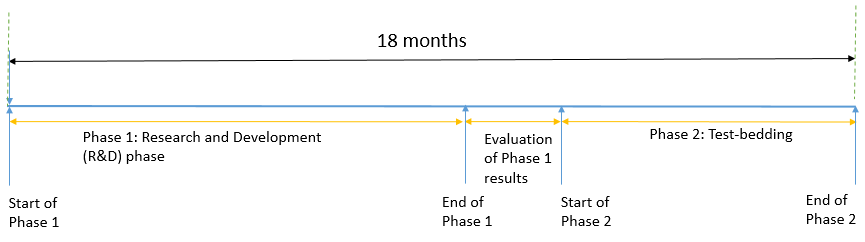 Figure 2: Schematic diagram for project timeline comprising Phase 1 (R&D phase), Phase 1 evaluation and Phase 2 (test-bedding phase)
5. Eligiility and Funding Support
5.1. This call is targeted at Singapore-registered companies1, as well as Institutes of Higher Learning and Research Institutes based in Singapore, with the following funding support for successful applicants:
| Applicant – Nature of Organisation |
Funding Support |
| Institutes of Higher Learning/Research Institutes |
Up to 100% of qualifying project cost |
| Local Small and Medium Enterprises |
Up to 70% of qualifying project cost |
| Large Local Enterprises |
Up to 30% of qualifying project cost |
| Multi-National Companies |
Up to 30% of qualifying project cost |
1 Companies registered with the Accounting and Corporate Regulatory Authority (ACRA), including foreign companies registered and based in Singapore.
6. Evaluation Criteria
6.1. The research and development work is to be conducted in Singapore. Proposals will be evaluated against the following criteria:
| S/N |
Evaluation Criterion |
Weightage (%) |
| 1. |
Effectiveness of Solutions
The proposal will be assessed on the technical feasibility of the solutions and how they effectively address the respective Work Area(s). The proposal would also be evaluated on the method practicality, completeness in addressing the proposal requirements in Section 3, as well as appropriateness of the proposed project milestones and deliverables.
|
30 |
| 2. |
Feasibility of Deployment in Actual Operational Environment
Solutions will be assessed on their potential scalability and feasibility for deployment in an actual operational environment, as well as the anticipated operating and life cycle costs for the deployment. Simple solutions that require minimal, installations and training as well as low manpower reliance would be preferred.
|
30 |
| 3. |
Expertise and Capacity to Execute the Project
The project team will be assessed on whether they have the requisite capabilities and resources to undertake the research/innovation project.
|
20 |
| 4. |
Cost Competitiveness
The proposal will be assessed on the cost and benefits of the proposed solutions, and relative cost to other proposals. |
20 |
|
Total Score |
100 |
7. Rights of Awarding
7.1. NEA reserves the right to select proposals in full or in parts to be awarded. For the avoidance of doubt, NEA reserves the right not to award funding to any proposal.
8. Submission Procedure
8.1. Each proposal must be submitted in accordance with the application form template together with all supporting documents. Please download all files below:
8.2. The softcopy of the application form and all supporting documents shall be submitted to
vectorcontrol_innovation@nea.gov.sg no later than
22 May 2019, 11:00 hours (Singapore Time, GMT+8).
9. Contact Details9.1. For enquiries on this call, please contact NEA at vectorcontrol_innovation@nea.gov.sg.
10. Overview
10.1. For information presented at the briefing session held on 23 Apr 2019, please click here.