7 Euro 2/3 Category C diesel vehicle owners can make use of the e-Service “Calculator – Early Turnover Scheme” available at the ONE.MOTORING portal (www.onemotoring.com.sg) to find out more about the benefits of the ETS[4].
8 Vehicle owners and motor dealers may contact LTA at 1800-CALL LTA (2255-582) or NEA at 1800-CALL NEA (2255-632) for enquiries on the ETS.
[3] Category C vehicles have a statutory lifespan of 20 years. The bonus COE incentive will be based on the remaining statutory lifespan of the vehicle at the point of deregistration.
[4] LTA is currently enhancing the calculator to reflect the revised incentives from 1 August 2017.
For more information, please contact us at 1800-CALL NEA (1800-2255 632) or submit your enquiries electronically via the
| Pollutant |
Singapore Targets by 2020 |
Long Term Targets
|
Sulphur Dioxide
(SO2) |
24-hour mean: 50µg/m3
(WHO Interim Target)
Annual mean: 15 µg/m3
(Sustainable Singapore Blueprint target)
|
24-hour mean: 20µg/m3
(WHO Final)
|
|
Particulate Matter
(PM2.5)
|
Annual mean: 12µg/m3
(Sustainable Singapore Blueprint target)[5]
24-hour mean: 37.5µg/m3
(WHO Interim Target)
|
Annual mean: 10µg/m3
24-hour mean: 25µg/m3
|
|
Particulate Matter
(PM10)
|
Annual mean: 20 µg/m3
24-hour mean: 50 µg/m3
(WHO Final)
|
| Ozone |
8-hour mean: 100µg/m3
(WHO Final)
|
| Nitrogen Dioxide (NO2) |
Annual mean: 40µg/m3
1-hour mean: 200µg/m3
(WHO Final)
|
| Carbon Monoxide (CO) |
8-hour mean: 10mg/m3
1-hour mean: 30mg/m3
(WHO Final)
|
[5] Sustainable Singapore Blueprint annual target for PM2.5 of 12µg/m3 will be retained and aligned with WHO Interim Target of 37.5 µg/m3 for 24-hour mean.
ANNEX B
Eligibility Criteria and Details for the Enhanced Early Turnover Scheme
1 To be eligible for the scheme, the following criteria must be met:
(I) The existing vehicle must be:
- A Category C vehicle and not COE-exempted;
- Propelled by diesel, diesel-Compressed Natural Gas (CNG) or diesel-electric;
- Under the permanent ownership of the registered owner;
- Registration and deregistration dates are within the following period:
Registration Date: On or after 1 January 2001 to 30 September 2006[6]
Deregistration Date: On or after 1 August 2017 to 31 July 2019
- Properly disposed of (i.e. scrapped or exported and COE rebate, if any, successfully granted) before registration of the replacement vehicle; and
- Have at least one day of COE life remaining or at least one day of its remaining statutory lifespan, at the point of deregistration.
(II) The replacement vehicle must be:
- A Category C vehicle and not COE-exempted.
- Any vehicle type, e.g. an existing Light Goods Vehicle (LGV) can be replaced with a Heavy Goods Vehicle (HGV). However, the registered owner must fulfil the registration conditions of the replacement vehicle, such as obtaining LTA’s prior approval for the registration of a private hire bus, etc;
- Electric vehicle, or Euro 6-compliant if it is propelled by diesel, diesel-CNG, diesel-electric, CNG, petrol, petrol-CNG or petrol-electric;
- Diesel, diesel-CNG or diesel-electric vehicles with Maximum Laden Weight of less than or equal to 3,500kg can also be JPN2009 with Euro 6 PN Limit-compliant;
- Diesel, diesel-CNG or diesel-electric vehicles with Maximum Laden Weight of more than 3,500kg can also be PPNLT with Euro 6 PM Number-compliant;
- Petrol, petrol-CNG, petrol-electric or CNG vehicles can also be JPN2009 with Euro 6 PN Limit-compliant if using Gasoline Direct Injection technology or JPN2009-compliant if using Port Fuel Injection technology;
- Registered in the name of the last registered owner of the existing vehicle[7]; and
-
Registered within 1 month from the date of deregistration of the existing vehicle
See illustrations:
For existing vehicle registered on or after 1 January 2001 to 30 September 2006 (Euro 2/3)
|
- If deregistered on 1 August 2017, the replacement vehicle must be registered by 31 August 2017.
- As scheme ends on 31 July 2019, the last date to deregister will therefore be 31 July 2019 and its replacement vehicle must be registered by 30 August 2019.
|
2 Vehicles contribute to about half of domestic PM emissions in Singapore, and diesel vehicles contribute to more than 90 per cent of total PM emissions from all petrol and diesel vehicles. The early replacement of older and more polluting diesel models with newer models, which comply with tighter emission standards, will reduce ambient PM levels.
3 The details of the 2 components of the current and enhanced scheme are as follows:
a. COE transfer. This will allow a transfer of the remaining COE validity period from an eligible vehicle to a new Euro 5/6-compliant vehicle. This would be more attractive to the vehicle owners than the usual approach of deregistering an old vehicle, getting a COE rebate based on their original COE price, and bidding for a new COE for the new vehicle.
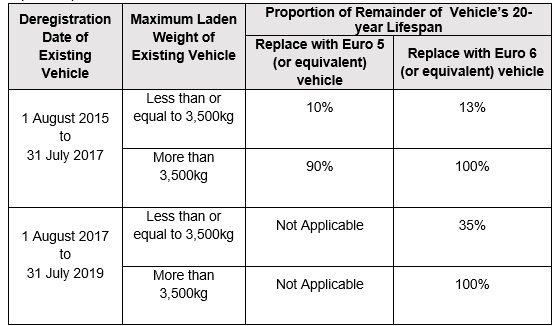
b. COE bonus. This is based on the remainder of the vehicles’ 20-year lifespan and structured as follows[8] in Table B-1:
Table B-1: COE Bonus for Euro 2/3 Cat C diesel Vehicles that turnover to Euro 5/6 (or equivalent) vehicles in current and enhanced scheme
[6] Euro 2/3 vehicles registered in October 2006 may be eligible for the ETS ifsupporting documents certifying the emissions standards of the vehicles are provided.
[7] Vehicle owners who wish to transfer their replacement vehicle to another owner can apply to LTA to effect the ownership transfer after registration of the replacement vehicle. Visit www.onemotoring.com.sg for vehicle ownership transfer procedures and forms.
[8] The bonus COE period would carry zero financial value. The cash value of the full 10-year COE for the replacement vehicle would be the transferred value of the remaining COE life of the existing vehicle (based on the old COE price) and the amount paid for the PQP top-up.
ANNEX C
Summary on PQP Payable and Calculation of COE
(A) How PQP Payable for the Replacement Vehicle is DerivedFor eligible vehicles that are deregistered between 1 August 2017 and 31 July 2019, the discounted PQP payable at the point of registration of the replacement vehicle will be computed as follows and rounded up to the nearest dollar:
(B) How the Value of the 10-year COE for the Replacement Vehicle is Calculated
Once registered, the value of the 10-year COE for the replacement vehicle will be calculated as follows:
ANNEX D
Sample Calculations of Benefits under Enhanced ETS
EXAMPLE 1Category C existing vehicle with MLW = 3,000kg
First Registration Date (FRD) between 1 January 2001 and 30 September 2006
Deregistered between 1 August 2017 and 31 July 2019
Has both unused COE and remainder of the 20-year lifespan at deregistration
(a) Replacement Vehicle
Emissions Standard: Euro 5
Not eligible under ETS as Scheme is no longer applicable to Euro V replacement vehicles
(b) Replacement Vehicle
Emissions Standard: Euro 6
Assumptions
| Existing Vehicle |
Replacement Vehicle |
QP paid = $20,000
FRD: 1 September 2001
10-year COE Expiry Date: 31 August 2021
Reach 20 years old on: 31 August 2021
Deregistration Date: 31 August 2017 |
PQP for Category C = $50,000
Registration Date: 31 August 2017 |
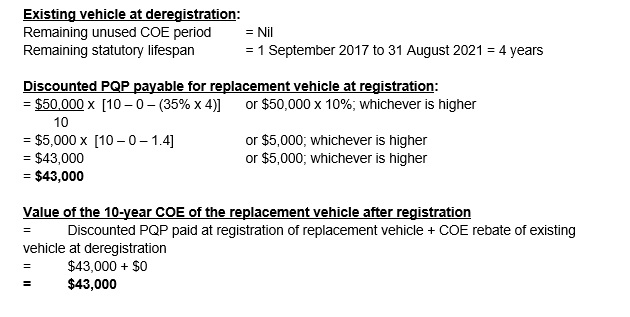
EXAMPLE 2Category C existing vehicle with MLW = 3,000kg
FRD between 1 January 2001 and 30 September 2006
Deregistered between 1 August 2017 and 31 July 2019
Has only remaining statutory lifespan at deregistration
(a) Replacement Vehicle
Emissions Standard: Euro 5
Not eligible under ETS as Scheme is no longer applicable to Euro 5 replacement vehicles
(b) Replacement Vehicle
Emissions Standard: Euro 6
Assumptions
| Existing Vehicle |
Replacement Vehicle |
QP paid = $20,000
FRD: 1 September 2001
10-year COE Expiry Date: 31 August 2017
Reach 20 years old on: 31 August 2021
Deregistration Date: 31 August 2017 |
PQP for Category C = $50,000
Registration Date: 31 August 2017
|
EXAMPLE 3Category C existing vehicle with MLW = 5,000kg
FRD between 1 January 2001 and 30 September 2006
Deregistered between 1 August 2017 and 31 July 2019
Has both unused COE and remaining statutory lifespan at deregistration
(a) Replacement Vehicle
Emissions Standard: Euro 5
Not eligible under ETS as Scheme is no longer applicable to Euro 5 replacement vehicles
(b) Replacement Vehicle
Emissions Standard: Euro 6
Assumptions
| Existing Vehicle |
Replacement Vehicle |
QP paid = $20,000
FRD: 1 September 2001
10-year COE Expiry Date: 31 August 2021
Reach 20 years old on: 31 August 2021
Deregistration Date: 31 August 2017 |
PQP for Category C = $50,000
Registration Date: 31 August 2017
|
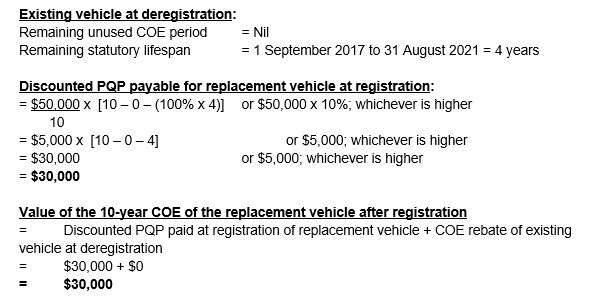
EXAMPLE 4Category C existing vehicle with MLW = 5,000kg
FRD between 1 January 2001 and 30 September 2006
Deregistered between 1 August 2017 and 31 July 2019
Has only remaining statutory lifespan at deregistration
(a) Replacement Vehicle
Emissions Standard: Euro 5
Not eligible under ETS as scheme is no longer applicable to Euro 5 replacement vehicles
(b) Replacement Vehicle
Emissions Standard: Euro 6
Assumptions
| Existing Vehicle |
Replacement Vehicle |
QP paid = $20,000
FRD: 1 September 2001
10-year COE Expiry Date: 31 August 2017
Reach 20 years old on: 31 August 2021
Deregistration Date: 31 August 2017 |
PQP for Category C = $50,000
Registration Date: 31 August 2017
|