Residential premises do not come under the list of places where smoking is prohibited.
In NEA’s deployment of optical surveillance cameras for high-rise littering (HRL) enforcement, safeguards have been put in place to protect residents’ privacy. An example is to position the cameras to focus only on the external façade of buildings where surveillance is being carried out. These cameras do not need to look into windows, thus protecting residents’ privacy. This is possible as NEA utilises video analytics with the cameras to detect falling high-rise litter on the façade of the building, and NEA officers are alerted once litter is detected being thrown out of windows. These video analytics cannot be used to detect lit cigarettes or smoking in homes, as there is no object or anything falling from the window.
See Figures 1 and 2.


Figures 1 & 2: Placement of optical surveillance cameras at ground level, pointing upwards – different views. The video analytics in the cameras detect falling objects on the façade of the building.
On the other hand, thermal surveillance cameras are used to detect smoking offences, as they can alert our officers to the presence of a lit cigarette, which emits high heat signature. These cameras are currently positioned along common corridors where smoking is prohibited. They do not point into people’s homes, as smoking inside residential units is not an offence, thus also ensuring residents’ privacy.
The surveillance range of thermal cameras is usually quite limited, compared to optical cameras. Hence, outside of more confined corridor areas, deploying thermal cameras for surveillance of windows will be challenging due to its limited range. See Figures 3 and 4.
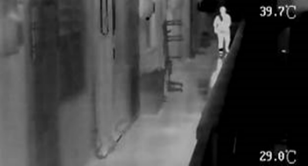
Figure 3: Placement of thermal surveillance camera along a common corridor, to detect errant acts of smoking
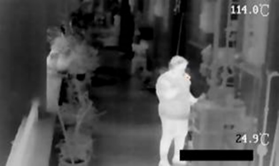
Figure 4: Act of smoking along a common corridor captured by a thermal camera.
The following paragraphs elaborate the challenges of deploying thermal cameras for the detection of smoking acts at windows and balconies:
• Deployment challenges. To catch a smoking act within homes, the thermal camera will have to be deployed to point at the window of the suspected unit. As the smoker may be standing away from the edge of the window or balcony, the camera needs to be sited at a relatively shallower angle in order to have a clear field of view into the window/balcony. Geometry-wise, cameras deployed at ground level can only scan the lower floors (up to about five floors maximum, depending on availability of horizontal displacement distance on the ground for camera deployment).
To conduct surveillance of windows and balconies at high floors will require the cameras to be deployed at higher ground, such as the corridor or staircase of an adjacent block. This can be challenging as a suitable vantage point may not be available, depending on the design and facing of flats. In addition, the design of some HDB flats is such that windows are located at recesses (e.g. kitchen window) and cannot be easily seen from the ground level. It is near impossible to detect smokers who are smoking at these windows. See Figure 5.
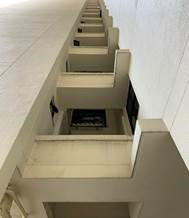
Figure 5: Example of an obstructed view of window from the ground.
- Privacy issues. NEA’s surveillance cameras for detecting HRL are mostly deployed at the ground level, as long as a suitable vantage point can be found. Typically, the steeper angles that come with ground deployment mean that only the exterior of the flats are in the field of view of the cameras. NEA may consider deploying surveillance cameras at higher vantage points found in adjacent blocks only for egregious HRL cases, and after a thorough assessment concluding that there are no suitable vantage points for deployment on the ground. Furthermore, HRL cameras rely on video analytics to detect a falling object at the façade of the building, and do not require officers to look directly into the windows of people’s homes. The NEA officer is alerted to and only needs to view the short segment of the video where the falling litter is detected, instead of the whole length of the video. All these measures help to minimise privacy concerns, which is not applicable to the thermal camera current technological capabilities.

Figure 6: Example of how surveillance cameras may be intrusive when pointed at homes.
- Technological/technical limitations. Deploying surveillance cameras at adjacent blocks also has several limitations, and may not always be possible. Firstly, there may not be suitable common corridors or stairwells for camera deployment at adjacent blocks. Secondly, the adjacent blocks may be beyond the range of the thermal cameras to detect the heat source from a lit cigarette. Last but not least, the smoker can be easily blocked by walls/columns, curtains, or the reflective surfaces of windows. This is because thermal cameras cannot detect the heat source of a lit cigarette held behind a curtain, glass window, or concrete wall.
While NEA continues to monitor technological developments and innovations in this area to safeguard public health, mitigating second-hand cigarette smoke in homes ultimately requires everyone to play their part. Smokers are encouraged to exercise social responsibility and refrain from lighting up where second-hand tobacco smoke can affect those around them, including neighbours living beside, above or below them. Close the door and windows if you do smoke at home. Otherwise, go downstairs and smoke away from your block in an area where smoking is not prohibited, such as open spaces and unsheltered carparks. Friendly and timely reminders from family, friends and other members of the community can also help reinforce the right social behaviour and norms. We will continue to adopt a balanced approach in the use of camera surveillance systems to detect smoking activity in prohibited places.
Posted on 21 Apr 2025 12:15 PM